





 Local Weather
 Weather Forecast
 Weather Warnings
 Weather for Fishermen
 Weather for Marine
 Weather for Aviation
 Weather Monitoring Imagery
 GIS Weather Service
 Tropical Cyclone
 China Weather
 World Weather
 Climate Information Service
 Warnings & Signals Database
 Statistics of Special Weather Events
 Monthly Weather Summary
 Climate Change
 El Nino and La Nina
 Earthquakes
 Tsunamis
 Tide
Tide Geomagnetism
 Space Weather
 Weather Information for Astronomical Observation
 Interactive Sun Path Diagram
 Astronomical Data
 Interesting Astronomical Phenomena
 Time Services
 Calendar
 Almanac
 Real time Radiation level in Hong Kong
 Understanding Radiation
 Radiation Monitoring, Assessment and Protection
 Environmental Radiation Monitoring Programme
 Daya Bay Contingency Plan
 Related Sites
 Schools
 Travel
 Sports
 Outdoor Photography
 CWOS
CWOS Senior Citizens
 Stargazers
 FoOb
FoOb My Little Observatory
 Interactive Map of Storm Damage by Mangkhut
 Educational Resources
 360 Tour of HKO
 Decoding Radiation
 A Tour of Tropical Cyclones
 Cloud Appreciation by Dr Tin
 International Cloud Atlas
 Guided Tour
 Courses and Activities for the Public
 Subscription of e-Bulletins
 Research Forum
 Publications
 International Atomic Energy Agency
 Regional Specialized Meteorological Centre for nowcasting
 Asian Aviation Meteorological Center
 Social Media
 Press Releases
 What's New
 HKO Updates
 LegCo Questions and Answers
 Weather Chit Chat
 Observatory's Blog
 Weather On-Air
 Cool Met Stuff
 Central Briefing
 Tropical Cyclone Report Broadcast
 Observatory's News
 Vacancies
 Tender Notices
 Apps
Apps Personalized Website
 Weather Wizard
 Weather Information in Text
 Weather Information in RSS
 Audio Web Page
 Forms
Forms Open Data
 HKO Corporate Video
 Vision and Mission
 Organizational Structure
 Quality Management
 Hong Kong Observatory – The Facts
 Hong Kong Observatory 2024
 Our Services
 Programme Areas of the Observatory
 History of the Hong Kong Observatory
 Career@HKO
 Visitors Figures
 Hong Kong Observatory Open Day 2025


Thermal Vision for Sky Observation
Thermal Vision for Sky Observation
LEE Chi-wai
January 2022
Human eyes can only see a narrow frequency spectrum, known as visible light, of the electromagnetic wave. The thermal infrared (IR) is another electromagnetic wave outside the visible light spectrum that is of natural origin that we frequently come across. How would the environment look like if we see them in the thermal IR spectrum?
Thermal IR camera pictures the temperature of the object. The thermal IR camera sees the thermal IR emitted by the object itself without any external light source. The hotter the object is, the brighter it appears in the thermal IR camera. While such function may not be useful for observation during day time, it would be useful at night when the target object is not well illuminated. Some examples of thermal IR images are shown in figures 1-3. For comparison, the visible images taken at the same time by another camera nearby is also shown. While during day time, the thermal IR image lacks certain details shown in the visible image (figure 1), it is able to see more at night (figures 2 and 3). For example, in figure 2, the Sunset Peak can be seen in the thermal image but not in the visible image. It is also difficult to tell if it is cloudy from the visible images shown in figure 3 alone while the thermal images can easily distinguish between fine and cloudy sky.
The Observatory is further exploring the use of the thermal IR cameras in weather observations.
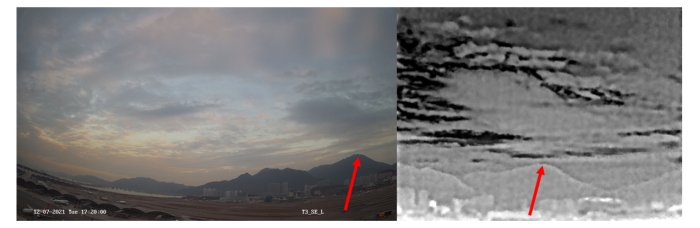
Figure 1 Visible (left) and thermal (right) images of the sky with some cloud during day time. For the ease of comparison, the Sunset Peak on the two pictures are indicated by arrows.
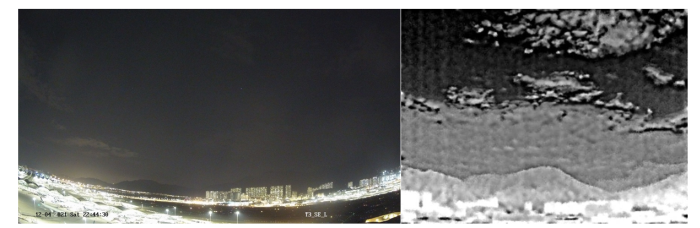
Figure 2 Visible (left) and thermal (right) images of the sky with some cloud during night time.
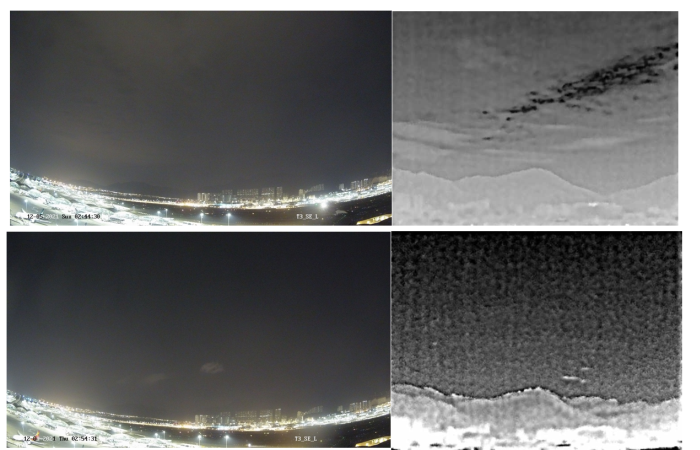
Figure 3 Visible (left) and thermal (right) images of the sky during night time. The images on the top were taken when it was cloudy while the images on the bottom were taken when it was fine.